Tuesday, May 17, 2011

Notables from ICFF 2011

Lack of funding kept Brooklyn Designs from running concurrently with this year's International Contemporary Furniture Fair, but the New York borough was everywhere at the Jacob Javits Convention Center. Some of the usual suspects made ICFF appearances, including 3Form, Bernhardt Design and Herman Miller, but the little guys—from Brooklyn and elsewhere—stole the show.
The Hi-Phi System, interlocking furniture components by New York Arbor (Brooklyn). The pieces connect to produce tables, stools and storage.
The V-Luxe for iPad (right) and V-Luxe Junior for iPhone/iPod Touch. The larger screen holder swivels, and the drawer below it is perfect for a wireless speaker. BKNYdesign (Brooklyn) produces the pieces; consoles and storage units may follow.
Irresistible accessories from Areaware (Brooklyn). Jonas Damon designed the Alarm Dock for iPhone/iPod Touch. 
Scrap Lights, fabricated from recycled cardboard, and the Slice Cafe/Dining Chair, from single planks of plywood, were the little guys that did it for Graypants (Seattle).
Color out of California: Custom glass pendants and home accessories from Caleb Siemon & Carmon Salazar (Santa Ana)
Designer Lisa Sacaris (Houston) handpaints her wool felt textiles and wall coverings. Photo courtesy lisasacaris.com.
A touch of whimsy from England: the Bookshelf Wallpaper behind the Rocking Lamp by Mineheart
The Zon, the dimmable LED work lamp from Peter Stathis & Virtual Studio (San Francisco)
Designer Eric Slayton (Brooklyn) has a way with concrete, block wood and steel.
Herman Miller's Aluminum Series, by Charles & Ray Eames, goes back to the future.
The Inspiration and Process Series of notebooks from Moleskine.
A splash of sunshine in the newest lounge from Italy's Sedes Regia


Monday, May 16, 2011

American Design Club's Use Me Exhibit

The American Design Club, founded in 2008, aims to shine a brighter spotlight on U.S. furniture/product designers. All the functional, minimal pieces in this year's exhibition, called Use Me, are available for purchase. The show's on until May 17 at the American Design Building, 45 Great Jones Street, in East Village/Noho, New York. Make sure to check out what else is on display on the way to the top floor.

From top: Iacoli & McAllister's light fixtures and chairs; chairs by RISD student designers Rosie Li and Vivian Chiu, screen by fellow student Misha Kahn; candlesticks by Alexandra  Snook; and Grain's Hemp Mirror.
Pieces from Fort Standard, comprised of wood and marble
End tables form the Brooklyn–based Uhuru's War Craft Line, on the third floor of the American Design Building. The components are either reclaimed from the USS North Carolina—built at the Brooklyn Navy Yard—or reference the design of the celebrated World War II battleship.

Pendant lamps by David Weeks

Friday, May 6, 2011

Hi, Mom!

In honor of Mother's Day, a tribute to three mothers of modern design.
Charlotte Perriand lounging in the LC4 in 1928. Photo courtesy apartmenttherapy.comhttp://www.apartmenttherapy.com/ny/retrospect/corb-your-enthusiasm-the-woman-behind-le-corbusiers-furniture-designs-charlotte-perriand-retrospect-098469.
Architect-designer Charlotte Perriand (1903–1999) had to contend with doors closing resolutely in her face when she applied for design jobs in 1920s Paris, despite the gains made by women in Europe after World War I. Modernist icon Le Corbusier himself rudely rejected her by saying, "We don't embroider cushions here," only to have a change of heart after his design and business partner, cousin Pierre Jeanneret, took him to see her tubular steel furniture at the Salon D'Automne design exhibition in 1927. The resulting collaboration yielded some of the 20th century's most recognizable pieces, including the Chaise Longue (LC4, above) and the Grand Confort B302 (LC3). Perriand left Corbu's studio in 1937 (although she was to collaborate with the pair again over the years) and went on to design furniture and interiors largely influence by her time in Japan and southeast Asia.
Top, Perriand's Sub-Sahara Bench (ca. 1950s); the Table Gorge (1954). Photos courtesy Magen Galleryhttp://www.magenxxcentury.com/designers/charlotte-perriand/bio/.
Marianne Brandt (1893–1983) also knew something about pigeonholing. A star pupil from her first semester at the famed Bauhaus in 1924, she was nonetheless barred from entering the architecture department and was instead steered in the metal workshops. But hers was the last laugh, as her designs went on to become some of the most recognizable of the Bauhaus output. She eventually succeeded her mentor, painter-photographer Lázsló Moholy-Nagy, as head of the metal workshop, during which time she collaborated with students and colleagues alike. Despite her acknowledged talents, Brandt was never able to secure a job as an industrial designer, but she taught until the mid-1950s. She turned from design to painting, and lived quietly until her death. Her fixtures still light the halls of the iconic Bauhaus school in Dessau, Germany, and her teapot is recognized even by those who claim to know nothing about design.
A self-portrait from the 1930s; the famous teapot, expressing the basic tenets of the Bauhaus: geometry, form and function—and no more (courtesy Bauhaus Archiv, Berlin) http://www.bauhaus.de/index+M52087573ab0.html.
Eileen Gray (1878–1976) fought her own battles. Her interiors and furniture were synonymous with early modernism and the misnamed Art Deco era, but she didn't receive proper due until years later, after the respected Italian design magazine Domus published an appreciation of her work in 1968. She began as a painter, traveling with her artist father to Italy as a child and later studying in Paris as a teenager. She became enamored of lacquer work, learning the craft from a Japanese master living in Paris. Her screens were sought after by wealthy clients and her lacquer work often adorned the interiors she designed for them. Her architectural output was very small but influential—she designed much of the furnishings for the homes she designed. She built herself a small home on the French coast and lived in obscurity until the 1970s, when her furniture was reissued, then badly copied for mass consumption. Today, much of her furniture is carefully reissued in numbered editions, but copies of her most famous piece, the E1027 table, can still be found almost everywhere.

Top, Le Destin (1914), a screen purchased by couturier Jacque Doucet (photo courtesy le-style-et-la-matiere.blogspot.com). The Transat armchair, 1929, was designed for the E-1027 house, on the French Mediterranean coast, as was the E-1027 side table.http://designmuseum.org/design/eileen-gray

Sunday, May 1, 2011

Why Flowers?

Spring at the Conservatory Garden in New York's Central Park. Courtesy harlembespoke.blogspot.com.
I couldn't help thinking about Tuscaloosa, AL, and other southern states reeling from powerful storms and tornadoes—or the people of Japan still experiencing aftershocks more than a month after a devastating earthquake and tsunami—while taking in the treasures on view at the Antique Garden Furniture Show and Sale at the New York Botanical Garden this past week. Stone urns and animals shared space with ironwork seating, playful accessories and, of course, flowers. It all seemed trivial all of a sudden. Why do we care so much about these things?

Because they afford us an escape, a respite from what seems immeasurable and indiscriminate destruction. Flowers serve a powerful function, don't forget: They propagate their respective species, never mind captivating us with their color and beauty. Flowers, gardens and, yes, spring remind us that life continues and that even among the ashes, beauty can be found.

From top: The displays of Treillage; Bob and Debbie Withington of Maine; and Dawn Hill Antiques.

Crocuses make as appearance on the High Line (photo courtesy thehighline.org/blog). Other blooms will come again later this summer.

Thursday, April 21, 2011

Change Is Going to Come


Gentrification—with all its benefits of enlarged tax bases, much needed energy, new businesses and, at least at first, a fresh mix of ethnicities and cultures—seems to lead to the removal of the very character and characters that attracted the newcomers in the first place, be it artists and their DIY galleries, low rents for large spaces or, most disturbing to many, diversity. Urban renewal, even at its best and best-intentioned, wreaks havoc as its double-edged impact slices through communities. The architects of such plans rarely involve the communities targeted, and those communities' residents don't always have the political muscle to make sure their voices are heard.

And yet change, and changing over, is a constant of urban life. Stores change management or expand to serve a growing customer base. Rooming houses become one-family mini-castles or duplex dreams for young professionals. Empty lots fill with modest five-story multi-unit dwellings, towers of luxury and businesses large and small. Harlem, the black mecca of yesteryear and today, rocks steadily with the changes wrought upon and within it. The East Village seems reinvented every 20 years, and today roils with the debates on gentrification and its demerits.

Lower East Side Project, from New York Magazine's Festival of Ideas blog archive (week of April 11, 2011): http://www.festivalofideasnyc.com/blog

South African architect Mokena Makeka knows a little something about change. He witnessed his country's move from the cruel, inhuman policies of apartheid to a democracy of a multi-ethnic southern Africa. However imperfect, the country moves forward, hiccuping stubbornly toward a future it proudly writes for itself.

But the legacy of the last century is stamped indelibly on South Africa's cities, and the monumental effort to change exasperates and exhilarates. He chronicles his own contributions at 2010's Design Indaba, the decade-young all-encompassing design conference held in Cape Town (Makeka's hometown) that addresses design in all its scope as it relates in very real ways to the worlds with which it interacts.

South African architect Mokena Makeka, with his Cape Town township sports center in the background. At 35, Makeka is one of the youngest architects making an impact in design and architecture in southern Africa and beyond.


A recent walk through West Chelsea brought Mr. Makeka's presentation to mind. Here was a section of Manhattan that had seen seismic shifts in its fortunes. At the turn of the 20th century, New York boasted the largest harbor in the world, and the immigrant men and women who worked the docks, through necessity, lived nearby. Chelsea was a sea of tenements, a cluster of substandard housing and even worse services. Parks were nonexistent and disease was rampant. The wealthier lived only a few avenues over, but it might as well have been a universe away. Urban renewal first reared its insistent head in the 1930s, with the advent of President Franklin Delano Roosevelt's New Deal and New York Mayor Fiorello LaGuardia's urgent lobbying for his ailing Depression-era city. 


The West Chelsea Department of Health building, a WPA project built in the 1930s
Church of the Holy Apostle in West Chelsea
The Hudson Guild spearheaded the earliest urban renewal drives in West Chelsea. The building that originally housed the nonprofit group was razed in the 1950s.
Today there are very few remnants of Chelsea's hardscrabble past. Glistening edifices now tower over the neighborhood, galleries show ever more expensive artwork and hordes invade the avenues west of Seventh Avenue for brunch, drinks and society events. The High Line, the railway turned park in the sky, is one of the few projects aimed at inviting everyone—young, old, rich, poor, New Yorker and tourist alike—to enjoy the best that the city has to offer. The project now serves as model to other urban centers looking to turn eyesores into treasures.
The High Line Park, with the buildings of Frank Gehry and Jean Nouvel filling the sky behind it.
Granted, few want reminders of a past that shows the city at its harsh and racist worst. Yet there's merit in just that kind of history, if only to show how far we've come and how far we can yet go. Yesterday's tenements become today's luxury lofts (SoHo, the Upper East Side and Brooklyn's Williamsburg are prime examples). What will tomorrow bring? Careful, thoughtful planning brings laudable results—visits to Central Harlem and areas of the South Bronx certainly bolster that argument—but impatience and greed win out more often than not. Can a sensitive designer like Mokena Makeka make it in New York? I'd like to think so. The conversion of the High Line is proof positive that he—or she—would find a place. Because as scary as change can be, the excitement of renewal—in its truest sense—is inescapable. And welcome.
Annabelle Selldorf's luxury tower at Eleventh Avenue
The Starrett-Lehigh Building, the only Art Moderne (and New York) building included in Philip Johnson's modern architecture MoMA exhibit in 1931, still looms large over Chelsea. Martha Stewart's publishing empire calls the building home.
This former waterfront warehouse was designed by Cass Gilbert, one of the many utilitarian buildings he worked on during his career. It will soon house a K-12 private school.
The new finds a place among what remains of the old Chelsea.


Thursday, April 7, 2011

Shining Into the 21st

Happy birthday, Billie Holiday.

She would have been 96 years old today. Instead, she died at age 44 in the summer of 1959, physically broken from years of abuse at the hands of lovers and boyfriends, seriously ill after years of drug use and alcoholism, under investigation and awaiting arrest for drug possession. It was an ignominious end to a famously miserable life.

And yet she lived—gloriously, magically, resolutely—through her music. That voice, short of range but rich with emotive power, reached a generation yearning for vibrations that shattered the glossy veneer of the flaccid pop of the 1930s and ’40s. From her first professional stint with Benny Goodman to her last triumphant concerts at Carnegie Hall, Holiday held sway, enveloping her audience with her pain and fruitless yearning for revelation and redemption, giving immeasurable joy as a result. There were others before and after her—Ella, Sarah, Dinah—but none fascinated like Billie. She earned her place among the musical stratosphere. Long may the band swing, sway and moan in heavenly ecstasy.

Planet Ill gives loving tribute: http://planetill.com/2010/04/happy-birthday-billie-holiday/

Shining on into the 21st century as well.

Ludwig Mies van der Rohe, born March 27, 1886.
Mies van der Rohe's Seagram Building,  in New York. Photo courtesy Wikipedia.
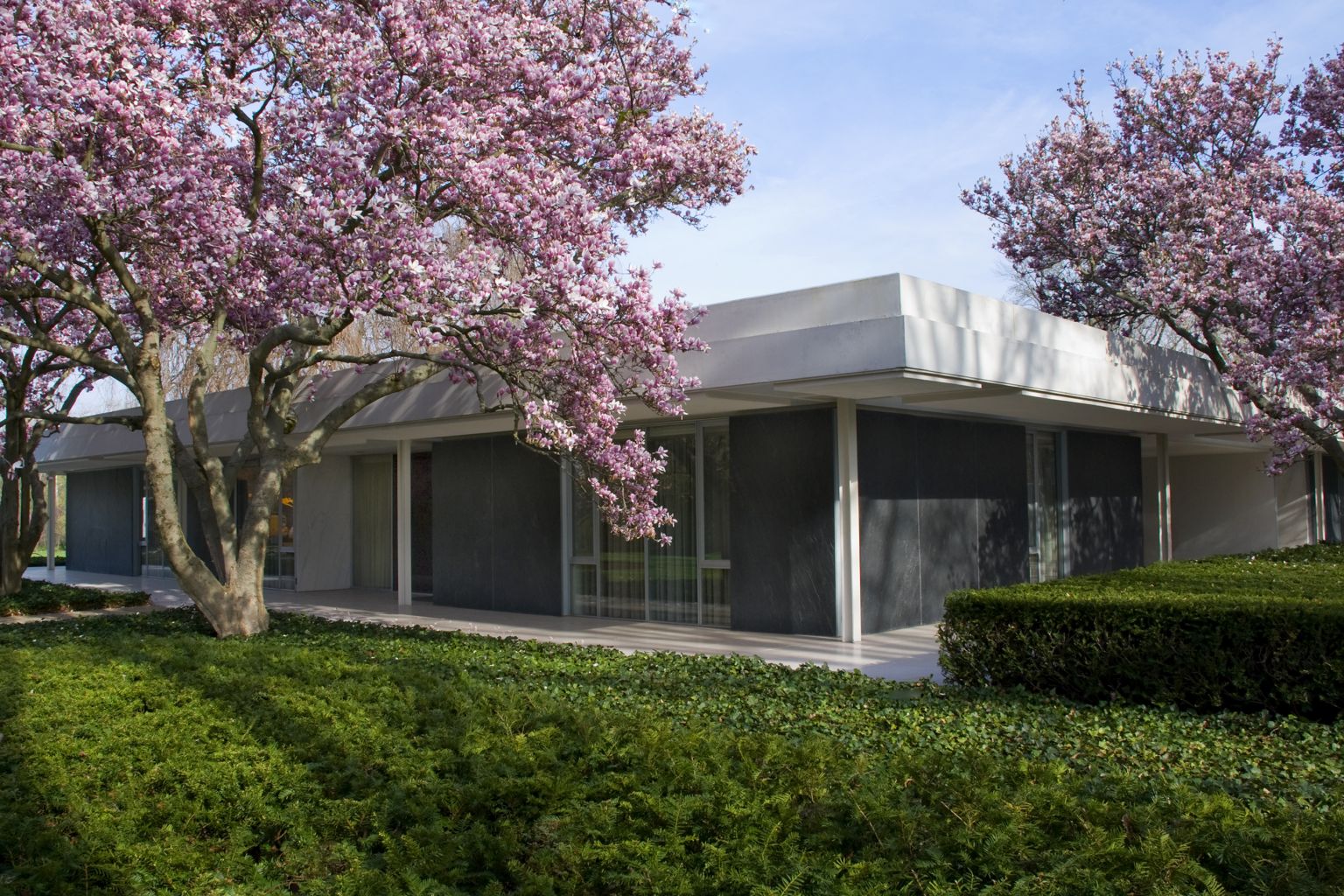
 Eero Saarinen. Miller House, commissioned in 1953, finally opens to the public.
Miller House, in Columbus, IN, designed by Saarinen with Alexander Girard (interiors) and Dan Kiley. Photos courtesy Indianapolis Museum of Art.
Purchase tickets here: http://www.imamuseum.org/millerhouse/tours

Gordon Bunshaft's Beinecke Rare Book and Manuscript Library, at the center of Yale University's expansive New Haven, CT, campus. The 50th anniversary of its completion is two years away.
The Beinecke during an early spring visit, 2010.


Saturday, April 2, 2011

Books Are Dead! Long Live Books!

Anacostia Library, in Washington, D.C., by the Freelon Group (courtesy Mark Herboth Photography via Architectural Record)
Libraries have been on my mind lately. I've always loved books and reading. When it came time to work on my own design thesis, a middle and high school, the complex's library was the natural focal point, where the community of students, instructors, parents and the neighborhood would meet and exchange ideas—and therefore teach. I found out something rather surprising on my journey. The death of the book has been greatly exaggerated.
The Philological Library of the Freie Universität Berlin offers 650 internet-accessible reading spaces on five levels. (photo courtesy Reinhard Görner via www.fu-berlin.de)
Physical books continue to change shape—hardcovers share shelf space with Nooks, Kindles and iPads—while libraries of all stripes experience a resurgence. Visits are up, and librarians can barely keep up with demand for the latest bestsellers. Job seekers, reeling from the latest economic downturn, stake out the free resources—computers and Internet service—and parents and children alike flock to reading nights and other gatherings for readers young and old.
The addition to Boston's Bloor/Gladstone Branch Library by RDH Architects (courtesy Tom Arban via Architectural Record)
The need for libraries predates the Great Recession, of course. Postwar West Berlin's master planner, Hans Scharoun, saw the need for a great cultural center to pull the struggling city together. An integral part of his plan was the State Library. Its recent restoration speaks to the continued vitality of the building. The iconic main branch of New York Public Library is currently undergoing its own restoration and renovation, and not a moment too soon.


Hans Scharoun's Staatsbibliothek, in what was West Berlin, faces Mies van der Rohe's Neue NationalGalerie.


Today's design community answers the call for this once and future public square in large ways and small, emphasizing the social aspects of the contemporary library. No community—whether a large university or small enclave in a rapidly changing city—remains immune to the pulls this institution holds on the world just outside its halls.