Thursday, September 22, 2011

To a Great City


Stillspotting NYC, an interdisciplinary project curated by the Guggenheim Museum, explores ways of finding quiet in the cacophony of senses that is urban living, especially in New York. Partnering with architects, artists, designers, composers and philosophers, assistant curator David van der Leer (from the museum's Architecture and Urban Studies program) and project associate Sarah Malaika steer the two-year project through its various incarnations in all of the city's five boroughs.
The sign to the will-call gallery at Castle Clinton, just paces from our first stop.
"To a Great City," the aptly titled second edition of Stillspotting NYC, in time for the tenth anniversary of the September 11 attacks (the first was in June, with artist Pedro Reyes installing in Brooklyn) features a partnership with architecture firm Snøhetta and the Estonian composer Arvo Pärt. Five sites, mostly in lower Manhattan and outdoors, were chosen, each featuring recorded works of Pärt's. Snøhetta subtly altered indoor and outdoors spaces, to quote the accompanying literature, "that embody the concept of a central musical tone and extend the perception of sound into the realm of space. . . . The staging . . . gradually transports visitors from the hustle and bustle of the streetscape to an elevated urban experience that makes them newly aware of the sense of hearing." Over the course of two weekends (it ends on September 25), this latest incarnation of the project promised to be moving, but I wasn't prepared for how deeply I would be touched.
Castle Clinton
On a cool, crisp Sunday, a week after the somber 9/11 anniversary, my friend N. and I arrived at Castle Clinton, the restored fort at the southern tip of Manhattan. How could we be transported from the insanity of the city without actually leaving it? We followed the suggested order (the sites can be visited in any order and at any time between 11am and 7pm) and entered Stillspot A.

From the first, tentative steps into Labyrinth at the Battery (just west of Castle Clinton) through a short journey to Governors Island and back to Manhattan and the World Trade Center, emotion ruled. I had traveled to Battery Park by bus from uptown Manhattan to take in the urban morning expecting nothing more than to listen to the music of a composer I'd admired for years. There was so much more.

For New Yorkers (and Washingtonians and Pennsylvanians), the wounds of September 11 remain remarkably fresh, even as the ache of loss dulls. My best friend pointed out recently that the reliving of the attacks by the media and the constant streams of visitors who have turned the World Trade Center into a tourist destination represent a constant "retraumatization" for those of us who witnessed the attacks and carry the knowledge that we knew someone—either directly or indirectly through friends, family and coworkers—who died on that awful day (sometimes New York is an incredibly small town). After hours of making sure that my family was safe (I have a cousin who worked in the North Tower—miraculously, her entire office was uptown for a conference at the moment the first plane hit), I made my way to the magazine where I worked and spend the next 15 hours reading, editing and piecing together an issue that covered that day's events. Even years later, a beautiful sky—a blue, impossibly bright and crystalline clear one that only happens in the fall—can make my heart race, and I reflectively search the sky for the plane that will end it all.
Entering Stillspot A, the Labyrinth at the Battery
"Silentium," from Arvo Pärt's Tabula Rasa, accompanied visitors on the walk.


These weather balloons marked each Stillspot.
All this was in my heart as I entered Stillspot A, the hole left in the sky by the attacks visible from where I stood. And it all dissipated as Pärt's music filled my ears (an iPod shuffle provided the private soundtrack) and the city fell away. Tears threatened almost immediately, but a surprising calm took hold and I finished the walk barely aware of other participants. N. and I talked in quiet tones as we made our way to the Governors Island ferry, then took in the beauty of the man-made world of Manhattan during the five-minute sail. On the island, Stillspot B and C deprived us of the skyline view then restored it, exploring the way we find escape—or don't—in our everyday claustrophobic comings and goings.
Manhattan from the Governors Island ferry
From the haunted magazine chambers of Fort Jay . . .

. . . to the open space at the Southeast Bastion, with the skyline as backdrop
Stillspot D, back in Manhattan at the Woolworth Building (closed since 2001 to all but those who toil inside its neo-Gothic walls), was a study in complements. The landmarked interiors represent an especially robust Beaux Arts period in New York, when ornamentation and decoration were used to celebrate commerce and prosperity. Pärt's choral work, until then minimal, was now rounded out by large orchestra and chorus [In Principio (In the Beginning)], filling the entrance halls, wrapping itself around the grand stairs, miniature gothic arches and exuberantly colored stained glass with an unexpected reverence—not for the naked capitalism of that era, but for the hope and optimism that spurred the striving.
On our way to the Woolworth Building
Photos aren't allowed inside the Woolworth, but I snuck in a couple on my iPhone.
Staircase detail
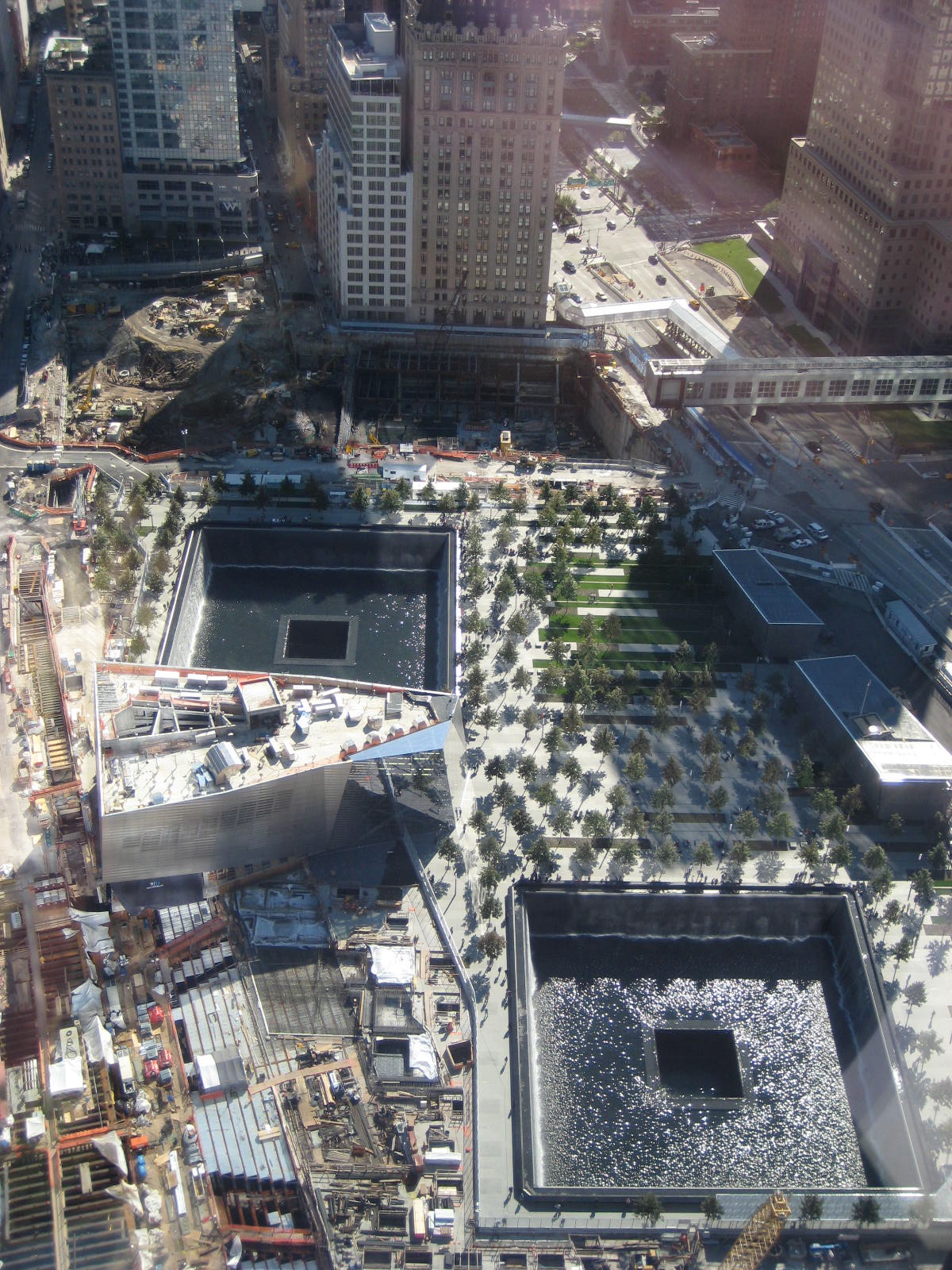
But the best and most moving Stillspot awaited us, at 7 World Trade Center, the first building completed in the rebuilding of the area. A panoramic view of Manhattan and the city greeted us as we exited the elevator on the 46th floor. I've studied, cursed, admired and loved this skyline my entire life and from the different vantage points—including the Empire State Building, the East River Bridges, Brooklyn, Queens and New Jersey, from sea and airplane—but nothing prepared me for this. I was across the street from where the Towers stood, and the awe I felt years before during a temp stint on one of the higher floors of the North Tower I felt again as I gazed at my city. But I wasn't in the North Tower. I was instead staring down at the September 11 Memorial Park and the waterfalls that have replaced both towers, and I let the tears finally fall.
The views from the 46th floor of 7 World Trade Center


"Reflecting Absence," Michael Arad's design for the 9/11 Memorial Park

Sunday, August 14, 2011

The Berlin Wall

After years of rising rhetoric, aggressive threats, intimidation and arrests, the Soviet Union made official the split between East and West Berlin. On August 13, 1961, sharp barbed wire wended through the heart of the city, with stone-faced soldiers guarding the new border. The Brandenburg Gate, once the marker to a thriving city center, now stood in a no-man's-land that wouldn't be crossed for 28 years. That wire became the Berlin Wall.
Soviet soldiers guard the barbed wire, that would become the Berlin Wall, trapping the Brandenburg Gate behind it. 
From John F. Kennedy ("Ich bin ein Berliner!") to Ronald Reagan ("Tear down this wall!"), American presidents railed against the "evil empire," keeping the Soviet Union and the Wall within their sites. West Berlin became an isolated republic of sorts; its citizens, though surrounded by East Germany and mere steps away from Eastern Europe, traveled freely from the Soviet Bloc to West Germany and beyond. East Berlin, meanwhile, took its place among the stunted cities seething behind the Iron Curtain.
East Berlin workers build a new, higher wall with curved top (1977).  Photo courtesy berlin-wall.org.
The Brandenburg Gate stands isolated and is disrepair in a no man's land breached by few (1977). Photo courtesy berlin-wall.org.
The graffiti-splattered western side of the Wall, 1986.
The Berlin Wall was in fact two walls in many places along its route, two concrete snakes jealously guarding their territories. To discourage defectors, East Germany reinforced the Wall many times over, increasing its height, adding a rounded top to eliminate climbers' grip, then barbed wire atop that curve. The guard towers standing between the two walls were constantly manned by ever watchful Russian and East German soldiers. Many East Berliners lost their lives trying to cross from East to West.

Twenty-eight years later, the Wall came down. In bits and pieces, Berliners from both sides of the divide tore chunks from the reinforced walls, daring Moscow to stop them. Soviet guards stood by, keeping their guns lowered as people scrambled through the enlarged holes in the Wall and jumped up in jubilation as they entered the forbidden west side. By November 1989, it was official: The Berlin Wall was no more—if more psychologically than physically—and the city and Germany started marching toward reunification.
The Wall, just before chunks were ripped down. Photo courtesy Christine Schoefer.

Soviet soldiers half-heartedly stand their ground as Berliners tear down a segment of the wall in 1989.

The Berlin Wall crumbled bit by bit, and today little of the physical walls actually remain. A line through much of the city's center marks where parts of the Wall once stood. The Mauer neighborhood (the German word "mauer" literally means "wall") hosts the last large segment of the border, and a memorial park now stands in the former no-man's-land. The city's grid has been restored (as it were—Berlin developed in a haphazard way, reflecting the different ambitions of the royal families that took up residence in the 19th century), and neighborhoods east and west are thriving, full of energy and tourists. All seems well and healed, as development fueled by the German economy and foreign investment pounds on.
The line marking where the Berlin Wall once stood in Potsdamer Platz
One of the very few watchtowers from the era of the Wall, near Potsdamer Platz.
A surviving section of the Wall. Several stand scattered near one of Berlin's business districts.
Yet scars remain. What the Berlin Wall wrought was a psychological split so deep that many Berliners of a certain age long for the days of separation and the predictability of Soviet life. There are still others who have never crossed the "boundary" into the sister part of the city, remaining rooted in a comforting if stale past or frightened by the uncertainty of democracy and the jolting crests and troughs of capitalism. A writer, raised in East German, recently posited that it would take another generation to truly obliterate the effects of the Berlin Wall. He may be right. But hope springs eternal, and it is to this hope that I choose to cling.
The largest surviving segment of the Berlin Wall, in the Mauer neighborhood
A memorial park now occupies a former no man's land behind the wall segment.


Looking east (second from above), then west. from the memorial park. This is the only street not restored to its pre-1961 state.
For young Berliners and tourists, this Wall Museum (one of several in the city) is as close as they'll come to the real thing, a segment of which remains across the street.


Thursday, July 7, 2011

Homeward Bound


The arch at Washington Square Park. Stanford White designed the marble edifice in 1892. 
Late last week, I took a walk through my old neighborhood. Greenwich Village, especially the West Village, witnessed my college years and well beyond. Visiting for any reason feels like a homecoming of sorts. Absent now are most of the shops offering enviable selections of new and used records/CDs, distinctive jewelry pieces and, of course, miles of cheap motorcycle jackets and leather backpacks. Gone too is the bohemian spirit, the feeling that you could do what you wanted with no judgements. (It's no accident that the gay rights movement started here—Stonewall Inn still stands, hosting an impromptu celebration after the passage of New York State's marriage equality act in June.) The great little dessert spots along Hudson Street, the candle shops and bookstores—sadly a part of my past. In their place are the overpriced boutiques and restaurants (however tasty the food they serve) and noise, noise, noise.
The First Presbyterian Church, founded in 1719, moved to its current site, on Fifth Avenue at West 12th Street, in the 1840s.
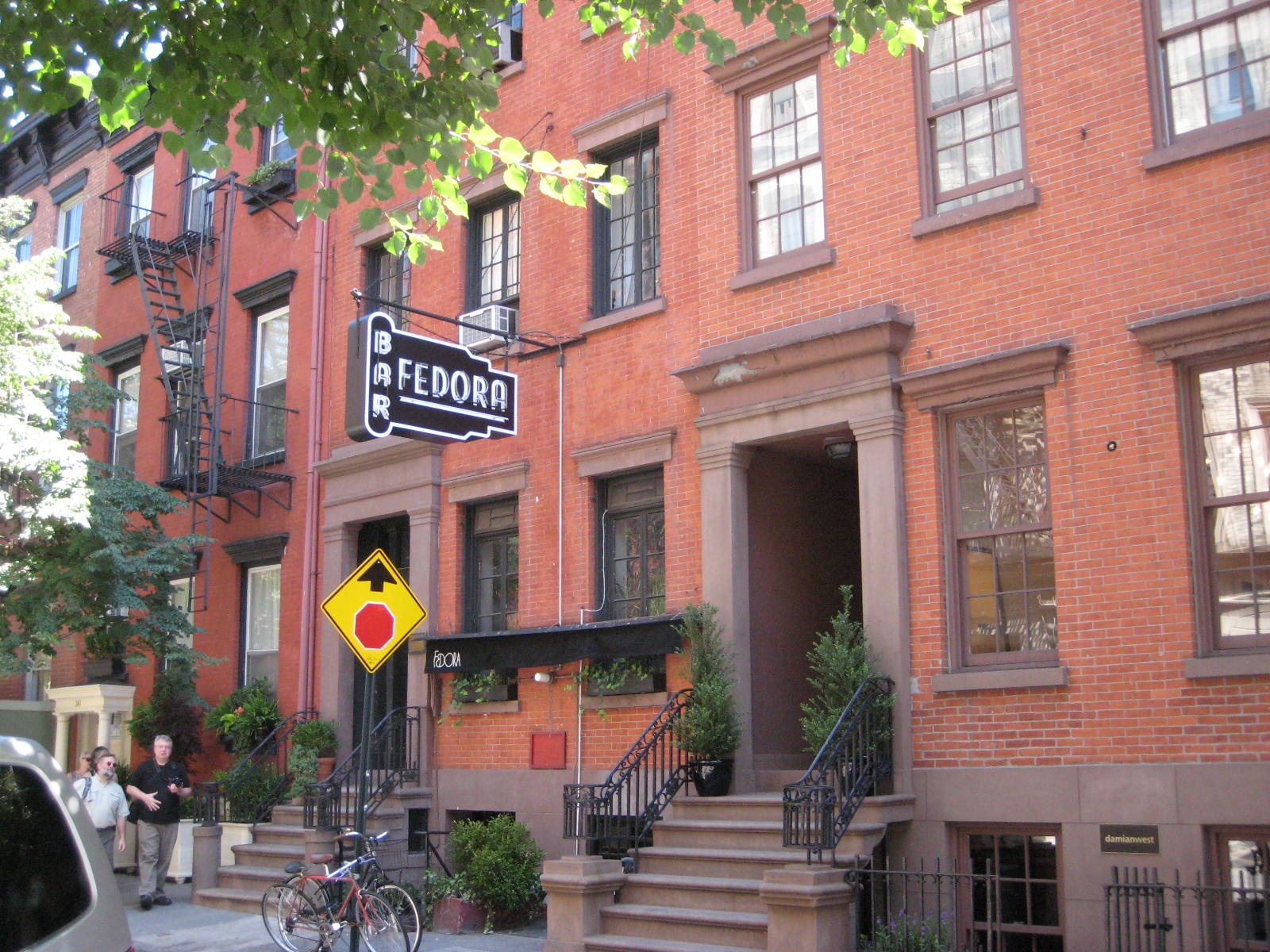
Lest I sound like the curmudgeon I'm certainly becoming, there's still much to see and like, especially in the West Village. Not erased is the history of the area. Greenwich Village was established in the early 17th century by Dutch and African settlers and developed much as a European rural hamlet would. It became a village officially nearly 100 years later, after the English firmly established their hold on Manhattan island. The roads developed in a haphazard way and were not changed after the imposition of the Manhattan grid another 100 years later. I can't help chuckling at confused tourists who find themselves at the corner of West 4th and West 10th, streets that only a few blocks east run perfectly parallel to each other.
A restored brick home on West 4th Street
The Fedora Bar, near the intersection of West 4th and West 10th Streets
One of the West Village's narrow, intimate streets
Washington Square Park, once farmland tilled by freed African slaves (which later became a cemetery for the indigent), is still the area's center (Fifth Avenue, which demarcates the east and west sides of Manhattan, ends at the the park's arch). The four-story townhouses along the park's north remain as well. The domestics who worked these and other houses in the village center lived west of Sixth Avenue. The housing conditions were less than ideal, and disease was rampant. When development opened up housing on Manhattan's west side, many uprooted and moved uptown, establishing what would come to be known as Chelsea and Hell's Kitchen.

By the 1950s, much of Greenwich Village was derelict, with dilapidated housing stock and few services—in short, a perfect place for artists, writers and the like to settle. The meatpacking district, in the northwesternmost point of the village, was home to seedy bars, warehouses, meat-packing companies (hence its name), prostitutes and, by the ’70s and ’80s, great clubs and all-night restaurants (we miss you Florent!). By the ’90s the great settlement of the moneyed had begun. Today the meatpacking district boasts boutique hotels, crowded restaurants and trendy clothing stores, and towers by the likes of architect Richard Meier overlook the Hudson River, sharing space with restored and renovated brick houses and converted warehouses. And there's the High Line Park, which begins at Gansevoort Street (the English retained the Dutch street names) and wends its way through Chelsea.
Washington Square Park's now centered fountain still attracts buskers and their fans.
The lush Abingdon Square Park
This stately prewar continues to stand vigil over Abingdon Square.
I still love the Village, despite the many changes. It vibrates with energy, and the shops offer window shopping rivaled only by Madison Avenue further uptown. Eighth Street still boasts some shady shops (although the 8th Street Playhouse that hosted the weekly midnight showing of The Rocky Horror Picture Show shuttered in the early ’90s). Many of the streets in the West Village retain their charming cobblestone paving (landmarked by the city decades ago), and there are many quiet pockets where it's easy to forget the insistent partying—or the West Side Highway—just blocks away. I walked along West 4th Street, visited Abingdon Square, which my first apartment overlooked (it was mostly dirt and cracked pavement then), smiled at the children screaming with delight at the playground a block away and walked west toward the High Line.

It was good to be home again.
The High Line and the Standard hotel beckon from Horatio Street.

Thursday, June 9, 2011

New York: Bridge & Tunnel Crowd

It's not flattering to be called bridge & tunnel in New York. You're the other, not of Manhattan, the sophisticated center of the world—or so some Manhattanites like to think. But the city reaches beyond the Upper East Side. It's East Harlem's El Barrio and the Bronx's resurgent Arthur Avenue, once the center of Italian life and culture in the borough. It's Citipark, the Queens home of the Mets, and Yankees Stadium, the born-again home of the love-'em-or-hate-'em Bronx Bombers. It's Flushing Meadow and Prospect Parks. It's the Bronx Zoo and Coney Island. It's the Staten Island Ferry and water taxis. It's all the small neighborhoods that witness lives large and small in more than 80 languages.
In short, it's home.

I was thinking about that as I gazed at the Brooklyn Bridge last weekend, waiting to beginning celebrating my friend's S.'s big birthday. How many folks were walking, running, biking and driving over the East River, making their way to spouses, kids, friends, siblings, neighbors.

It's one of the world's most storied bridges, and rightly so. A feat of engineering by German immigrant John Augustus Roebling, it was completed—after Mr. Roebling succumbed to an infection just two years into the project—by his American-born son, Washington, with the able assistance of his wife, Emily Warren, after he himself fell ill with decompression sickness (or "caisson's disease," as it was known then). The bridge took 13 years to build. When it opened in 1883, it was the longest suspension bridge in the world and the first steel-wire suspension bridge. Confidence in the bridge's soundness was cemented when, a year after its opening, P.T. Barnum paraded his elephants across the span to promote his circus's coming to town.
Today, the Brooklyn Bridge is one of three connecting Manhattan to Brooklyn, once a separate, thriving city and now and forever connected to its sister rival.
But none of the facts about the bridge echoed in my head. All I could see was the bridge in the gloaming, before the lights emblazoned the structure and nighttime overtook the piers. The light was amazing, the span's beauty breathtaking. Behind it regally stood the Manhattan and Williamsburg bridges, dutifully standing firm as thousands crossed their steel paths. And I wanted to be among them, the bridge & tunnel crowd, doing the very New York-est of things.

Tuesday, May 31, 2011

How Do You Get to Carnegie Hall?

Practice, practice, practice. So goes the old adage. Carnegie Hall's history, beauty and renown acoustics are being celebrated with a 120th-anniversary concert featuring the New York Philharmonic, which made its home at the music hall for 70 years before moving to the flashier Lincoln Center in the 1960s. Cellist Yo-Yo Ma, pianist Emanuel Ax and singer Audra McDonald perform the music of Antonin Dvorák, Ludwig van Beethoven, George Gershwin and Duke Ellington.
But the real draw is the hall itself. Its acoustics are world renown and rarely duplicated (though many have tried—look up the many revisions of Avery Fisher Hall, the Philharmonic's current home), and its history enviable—Dvorak's beloved New World Symphony debuted here on December 16, 1893; Liza Minelli sold out 10 shows in 1979, setting a record held to this day.

I caught Allen Ginsburg reciting his infamous Howl. I jumped when he spat and growled on the stage, so visceral was his anger even nearly 40 years after its publication in 1956. I've heard Händel's Messiah ring out in the hall. I watched awestruck as violinist Isaac Stern, Carnegie Hall's champion during the 1970s and ’80s who lobbied tirelessly for its careful renovation, performed joyfully and with youthful vigor in his beloved venue.

I wish I could be at tonight's show. A live broadcast is as close as I'll come. But I'll be back. All I need to get to Carnegie Hall is a Metrocard and my undying love of the arts.

Read more about Carnegie Hall here.